Mick Dumke and Ben Joravsky of the Reader are joined by special guest Cliff Kelley, the Governor of Talk Radio (and afternoon host on WVON) for our final wrap-up discussion before election day. We also talk ward politics, this week in 16, 21 and 29.
Some general themes: Bob Fioretti threw away his accomplishments as a thoughtful opposition leader for $80k. There’s no evidence that aldermen who battle with the mayor get worse services in their wards as punishment. And former Alderman Cliff Kelley believes the Council could be cut immediately to 25 wards and that it would make aldermen more independent, not less.
Quick snapshots on the election: Garcia would beat Emanuel easily if he’d had money early on and a slightly longer head-start. Not enough attention has been paid to issues like police stop-and-frisk in African-American neighborhoods. And the polls, especially the Trib poll, are under-counting Latinos. One panelist says Rahm wins, two say it’s a Chuy upset.
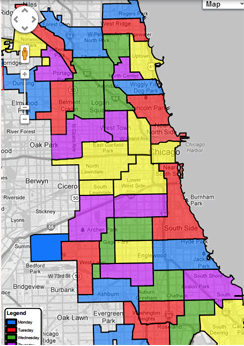
Then, from Ben Joravsky, the most radical reform idea of all: Since the garbage grid system seems to have been one of Mayor Emanuel’s big successes, making services more efficient and less costly, let’s just adopt the grid as our new ward boundaries. Look at that map – it’s compact and contiguous!
Joravsky says that he’s never seen proof that minority aldermen represent minority constituents any more effectively, etc. So maybe we don’t need to draw gerrymandered wards any more.
Three of Chicago’s most passionate political animals, all at one table.
It’s just days before the election results roll in and we know whether the people have elected Rahm or Chuy.
So it’s only natural that, among political animals, attention turns to last-minute polls. And to early voting patterns. Polls have shown Mayor Emanuel gaining significantly in wards with majorities of white registered voters, and, coincidentally, many of those same wards have shown a doubling of early voters since the February general election. What does it mean?
Syvia Puente, Executive Director of the Latino Policy Forum, thinks – not all that much.
“People are just going to be gone for spring break, so they’re just getting in their voting early,” she predicts. “So I think it means that turnout will be less next Tuesday, the day of the election. People are just shifting their priorities around for when they vote.”
Nevertheless, more than 20,000 new voters have registered before today, and while that’s not a huge number, it’s enough to have real impact in a close election. The question is, which side registered them?
It’s been pointed out that the Mayor is running with such fervor that he doesn’t look like a candidate who is confident that the polls are right and he’s got a fifteen-point lead.
“He’s certainly sweating more than he’s had to before,” explains Sun-Times columnist Neil Steinberg. “But I would argue that he’s campaigning really hard. And that’s classic Rahm Emanuel. He always does that.”
“He came on four years ago,” Steinberg continues. “We were in a looming financial disaster, which is still very much with us. However it’s not a disaster that the mayor can fix. It’s against the law for him to fix this problem. The pension issue is just a time-bomb that will destroy Chicago.There’s no question about that.”
Emanuel has been criticized for offering as his most salient plan for pension funding a bill that requires State, and possibly Illinois Supreme Court approval. Steinberg say Emanuel’s options are limited. “Mike Madigan is going to have to solve this,” he explains. “Because he’s the one with the power to do it. For some unfathomable reason, I would never guess why. Either that or you have to leave it up to God and say no one can solve it.”
Nevertheless, lots of Chicagoans have decided they’re going with Garcia. And that number might be larger than had originally been thought. Last week, Puente’s Latino Policy Forum commissioned a poll, and because it was built from the ground up as a Latino-orientd poll, it revealed some different voting patterns.
“The poll was conducted bilingually, in whatever language preference the person answered the phone,” she explains. If they answered “bueno”, the interview began in Spanish. If “hello”, it was English.
“In this poll, it showed that 46% responded in Spanish. And I don’t think any other poll around town has been able to use that methodology…so it really calls into question the veracity and the accuracy of the other polls that are out there.”
And the LPF-sponsored poll showed a clear preference for Garcia in majority-Hispanic wards, Puente tells us.
“What our polls showed is that about 61% of Latinos said they were favoring Chuy. 18% said they were favoring Rahm…but what surprised me is that 20% of the Latino voters surveyed said they were undecided.”
With 40% of respondents not expressing a preference for Garcia, it could indicate that Emanuel is stronger than he appears, since some number of the undecideds may simply be afraid to admit their Rahm preference to an obviously Latino polling firm. But, as everyone at the table agreed, we’re going to know the answer in just a couple of days.
When you have pretty much all of the money, you can define your opponent. By almost all accounts, Team Emauel has done a good job of defining Garcia, and Puente says Garcia is being victimized by it.
“What I’m still having trouble understanding is, I think Garcia has laid out a plan. I think it hasn’t been as well received for what’s in it,” she says. “But we have a mayor who’s been in office for four years, and we’re on the brink of fiscal bankruptcy. Now, he’s saying it’s a 30-year mess that’s been accumulating, and yes, that’s true. But this year we had to borrow two months into next year’s CPS budget to balance this year’s budget. That’s all on this mayor.”
One of my frustrations in reading the papers is that there’ll be three paragraphs on how Garcia doesn’t have a plan,” she continues, “and then two sentences on, well, Rahm really hasn’t given much detail either. So I think that speaks to the broader bias of our newspapers lecturing us on who should be the next mayor, and that they’re not giving equal time or equal critique to each of the candidates.”
But Steinberg is forceful in his defense of Emanuel.
“We needed to close fifty schools and Rahm did it,” he asserts. “If you watched Chicagoland, with Fenger High School, you’ve got 400 kids in a 1600-kid school…because the City’s hollowed out, and because any parent who has any sort of resources either takes them to the suburbs or sends them to a private school because sending their kids to the Chicago Public Schools is a form of child abuse in some places.”
“What we’re doing is a narrative for a public policy solution that we came up with 20 years ago when our schools really were a mess,” Puente counters. “We said, OK, now we’ve gotta start to create charters. That was a policy solution twenty years ago. Moving up now, I think what we’ve seen is charters have in some ways facilitated a disinvestment in our neighborhood schools. And now we’ve got to right the policy ship”
Despite his prediction that Emanuel will win, Steinberg says there would be benefits to a Garcia incumbency.
“If you look at the arc of numbers in America, Latinos are rising in power, in influence, and are a much larger factor in America,” he asserts. “And if Chuy Garcia becoming the Mayor of Chicago can be part of that story, I don’t think there’s anybody who cares about the city who’d think that’s a bad thing. The problems we’re facing are not some magic thing that Rahm Emanuel has figured out, obviously. On the other hand, if you look at power in Chicago and if I had to bet the house, I’d bet that Rahm wins on Tuesday.”
And what’s Puente’s prediction?
“It is spring break. There’s gonna be tens of thousand of teachers who are gonna be out of school, and a lot of Rahm’s base is gonna be away on spring break,” she claims. “I do think there’s a lot of enthusiasm, Chicago has people coming in from all around the country to work on the election for what it’s beginning to symbolize. But we all know the Mayor is very astute. He’s put in tremendous resources, and I think we’re not going to know.”
With so much attention focused on the mayoral race, it can be easy to forget that there are eighteen smaller runoffs being held in Chicago Wards. Some of them seem to be foregone conclusions, but in nearly half of these races there’s a hard-fought, sometimes vicious fight going on between evenly-matched opponents. We’ll take a look at some of each this week with Aldertrack’s Jimm Dispensa. All four wards share something in common: their aldermen were forced into a runoff after failing to achieve 50% of the vote. Three of our featured wards this week hug the western borders of Chicago, while one luxuriates on the City’s east coast.
Ward 18: Lona Lane (I) and Derrick Curtis
Auburn-Gresham, Marquette Park
“Derrick Curtis, interestingly, garnered more votes than incumbent Lona Lane in the General Election,” Dispensa tells us, but that’s not the most fascinating part. “Curtis is her Ward Superintendent and is the Democratic Committeeman. He has deep campaign experience and was responsible really, for working for Lane – passing petitions out on the street. He has the endorsement of the Sun-Times, the Tribune and the Defender. A lot of organized mail, a lot of feet on the street. The signage in the 18th Ward is pretty extreme. It’s a tough race to call, but the incumbent may be in trouble here.”
Ward 37: Emma Mitts (I) and Tara Stamps
Austin, West Humboldt Park
“More than half of the precincts in 37 gave Emma Mitts more than 50% 0f their vote,” says Dispensa, “so she missed avoiding a runoff by less than a hundred votes. The challenger is Chicago Public Schools teacher Tara Stamps, daughter of famous Civil Rights leader Marion Stamps. And here, unlike in the 18th, where each candidate is being neutral with regard to their mayoral candidate affiliation, here you have a clear alignment between the incumbent and Mayor Emanuel, and a very clear alignment between challenger Tara Stamps and Chuy Garcia.”
“It’s in part because Stamps is one of the candidates that the CTU got behind very early with a lot of money,” he explains. “And Ald. Mitts, you’ll recall, is a supporter of the City’s first WalMart, is a supporter of charter schools, so you saw this sort of natural tension building once a CTU-backed challenger got in the race. Of the 41 precincts in the 37th Ward, I think Tara Stamps got more than 40% of the vote in just three of those precincts…It’s a very strong possibility that the incumbent wins here.”
Ward 41: Mary O’Connor (I) and Anthony Napolitano
Edison Park, Edgebrook, Norwood Park
“It’s a huge ward,” Dispensa tells us. “A huge number of votes came out of the ward, about 15,000 in fact. and if you recall, for about 20 years we had one Republican on the City Council back when we had partisan municipal elections. So Alderman Doherty retires after 20 years, puts his own person in the race in 2011 and that person narrowly loses to Mary O’Connor. Now, it’s not clear if Anthony Napolitano, firefighter who’s raised a good amount of money and got 43% of the vote in February, is aligning himself with Alderman Doherty. (Local columnist Russ Stewart says he definiely is aligned.) O’Connor got 48% of the February vote.
O’Hare noise has been a major battle in the Ward, with Napolitano accusing O’Connor of doing nothing about the overhead jets. He accuses the Alderman of being too close to Mayor Emanuel and his policies.
But does attacking O’Connor for her nearly perfect record of voting with Mayor Emanuel hurt her? “It’s risky,” Dispensa says, “Because it isn’t clear how strong that anti-incumbent mood is in the 41st Ward. The message from the incumbent alderman is, look, we have overcrowded schools in these neighborhoods, in part because middle-class families are choosing public schools, and I’ve managed to get scarce capital dollars to build additions to those schools, so I think that the incumbent is saying it’s not so much that I’m with the mayor 100% of the time. Our community has needs, and I’ve met those needs.”
Ward 43: Michelle Smith (I) and Caroline Vickrey
Lincoln Park
According to Dispensa, “Alderman Smith has raised about $550,000, the most amount of money for any incumbent alderman in a runoff. Her opponent, Caroline Vickrey has raised about $130,000. That’s second or third-most for a non-incumbent challenger. It’s Lincoln Park. It’s the silk-stocking ward. And the incumbent has the endorsement of the former 43rd Ward alderman, Marty Oberman, and former Alderman Chuck Bernardini, as well as the challengers who didn’t make the general election. But Caroline Vickrey has on her side former alderman Bill Singer.”
The 43rd’s reputation as a bastion for independent politics seems to have pretty much evaporated in recent years, he says. “Now it doesn’t seem to be so much about, who’s more independent. Now it’s more about, who’s reaching out to the community in the right way to talk about development?”
And the 43rd Ward is one of the places in Chicago where support for Rahm Emanuel is almost unquestioned. “72% of the 43rd Ward mayoral votes went to Mayor Emanuel,” Dispensa says. “You have both candidates saying we both support Mayor Emanuel.”
“Incumbent Michelle Smith got 42% of the general election vote, and Caroline Vickry got 36%. I think it’s more of an uphill battle for the challenger in this case. I’d say it’s a tossup with an edge toward the incumbent.”
What happens when you fill the table with panelists who’ve been around a while? veterans of the Harold Washington years? These are people who love and breathe politics, and you get a surprisingly balanced view.
Right off the bat: Can Rahm Emanuel win?
“He likely will, but I don’t think it’s gonna be like fifteen points. I think it will be close,” asserts Beyond the Beltway‘s Bruce DuMont, one of the sharpest political analysts in Chicago.
“I think we have to be careful, because in the field it looks very differently,” adds Maria De Los Angeles Torres, Director and Professor of Latin American and Latino Studies at UIC. “Chuy Garcia is charismatic, he connects with people, and I think we’re not gonna know who’s gonna win the election until the day of the election, because it will be fought in the field.”
“It really is a ground game,” concludes Jacky Grimshaw, long-time political activist and former member of Harold Washington’s Cabinet. “And the union fight – those that are supporting Garcia versus those supporting Emanuel, the the unions that are into giving money versus those that are into giving troops. I think the troops side may be on the Garcia (side).”
Despite his victory prediction, DuMont sees many bumps in the road for the Mayor. And not having many enthusiastic ground troops is a big one. “It’s easy to write a check,” he explains. “It’s easy to make a robo-call. But it’s different from having perhaps thousands of people going into the precincts knocking on doors. I think that’s something that Rahm is not gonna have.” In politics, he says, that energy leading up to the 72 hrs before an election can be so critical.
And he’s seen waning enthusiasm for the Mayor first-hand. He brought up a long-time friend he has in the 19th Ward. “He doesn’t do anything that Mike Madigan doesn’t approve of,” He tells us. “He doesn’t sneeze until Mike Madigan says you can sneeze. And he shocked me when he told me he was out working the precincts for Chuy Garcia.”
So much of politics is rumor, innuendo and trying to stay a step beyond the other guy. And DuMont offers up just such a theory about what we used to call political power-houses.
“The reality is that, in many of those wards where their political leadership is, they’re only concerned about their own political future. They know the changing demographics of the city, and frankly, in their heart, they would probably just as soon have Rahm Emanuel go down to defeat because it would be their perception, at least in the Speaker’s case, that Chuy would need the Speaker a lot more than maybe Rahm might need the Speaker.”
So there’s that.
But ground-game or not, this election, Torres claims,”Has garnered national attention. The Latino Victory fund – Eva Longorio’s nice outfit, and Henry Munoz, big supporters of Obama, are supporting Chuy Garcia. So I think that’s seen as – it is the fight in the Democratic Party. What’s the next presidential election gonna look like? Are cities re-taking, in a sense, a populist approach to what are popular problems?”
For some time we’ve wanted to hear these folks’ take on he likelihood of a “black-brown coalition” heading into this election. One of the questioners at last night’s forum at Chicago State University asked Garcia, in essence, we – this mostly African-American crowd – are black, you’re hispanic, what are you gonna do for us?
Maria Torres is quick with an answer.
“There was never a black-latino coalition,” she declares. “Let’s be honest about it. There was an alliance of African Americans and progressive Latinos and progressive whites and Asians. (Today) we’re talking about young people that all the polls and all the surveys show are much more tolerant of each other. There’s been a huge influence of African-American culture onLatino and white youth. I think that base out there thinks about things a little differently than what we used to.”
Grimshaw’s response? “There are folks out there who’ve been trying to fuel a black-brown fight. And it’s an artificial fight. Because the situation for African-Americans, middle class, the unemployed – people are creating a false fight in terms of self-interest. The self interests of the African-American community and the Hispanic community are, I think, pretty much the same in the sense that they are all have-nots for the most part.”
So what was to be learned from last night’s candidate forum, in which both men showed up separately, and the audience appeared hostile toward Emanuel?
“He showed up there,” says DuMont. “He knew he was going into a hostile audience. And what I liked about what I saw last night – Chuy was making some political comments, and he was getting his cheers, even though they said ‘don’t cheer’ – what I liked? He went into the lion’s den and he was aggressive, he didn’t take any crap from anybody, including the moderators and the questioners. And I thought he was a guy in charge, on fire last night.”
Garcia, DuMont believes, didn’t do enough Wednesday night to make Emanuel accountable for the things he hasn’t handled well. So he gave the candidate some free advice.
“There are some columnists who are holding Rahm’s feet to the fire,” he began. “Not the Editorial Boards. But the principal goal of the challenger has got to be to go in there with a machete and literally slice (the incumbent) down. To remind people that, yes, he promised a thousand police officers. Yes he did this, yes, he backed down on this. And if you’re so great with all your wizards, then why has the city’s bond rating gone down on your watch if you’re so great? I think his commercials should be spent a lot more on that than on reminding people about the closed schools – the people who are upset about the closed schools are already voting for him.”
And DuMont went further, calling out the journalists and critics who have excoriated Garcia for not having a fiscal plan fully hatched two weeks before election.
“It is totally unrealistic for any challenger to really be able to say what they’re going to do,” he claims. “Because when they’re a challenger they don’t have access to everything. And whether it’s Barack Obama inheriting what George Bush gave him, or Mayor Emanuel inheriting the mess – the absolute fiscal nightmare of Richard M. Daley, it’s unfair. But it seems to me the news media, especially the editorial boards, they’re demanding from Chuy Garcia far more specificity, and far more knowledge of things – that you don’t know until you step into that fifth-floor office.”
How will early voting affect the mayoral election? 33,520 – a lot – have already done it.
“I think it’s good news for Rahm,” DuMont insists. “Rahm’s voters tend to be early voters because they’re busy, they’re out of town, they’re vacationing, and there’s more of a tradition of them voting than, I think, in the minority communities.”
Torres sees it differently. “all the ground troops that are out there and are gonna be working on election day, have made sure that they’re voting early,” she says, confident that they’ll be pulling for Garcia.
And the predictions continue.
“I believe that Chuy will likely come back to public safety as the issue leading up to the campaign, asserts DuMont. “Because we don’t know how many people are going to be shot and killed in this city before April 7. But I will bet it will lead the 10:00 news over fifty percent of the time.”
Rahm Emanuel’s “been a bold leader,” he continues. “He’s made a lot of very tough choices. I think the question is, do you want to reward him for that, or do you want him to just take bows and not acknowledge that there’s some pretty bad things that happened on his watch as well?”
The final word – and the final prediction, goes to Jacky Grimshaw.
“We’re getting a property tax increase. The City’s broke. There’s only so much you can do. These additional taxes are Springfield-derived taxes, not local. There’s no way that we’ll be able to pay the pension debt that’s coming due. Or the debt for operating expenses – borrowing for operating expenses…there’s no way that you can get it out of increasing the tax on electricity any more, or cell phones or junk food. You have to have a major source of revenue, and I think property taxes is going to be it. The only question is going to be – how much?”
Think the Rahm/Chuy race is the only show in town? There’s exciting action in many of the heated ward runoffs. Miguel de Valle, who was himself a mayoral candidate only 4 years ago and has for years been a progressive voice in Chicago politics, says there’s a “power struggle” going on in that vast stretch of largely Hispanic wards from Logan Square all the way to Harlem.
If you watch this show and you love Chicago politics, you’ll be hitting Rewind a lot, because this can be hard to follow. Let’s begin with Wards 31 and 36.
Ward 31
“Ray” Suarez (I) and “Milly” Santiago
Ward 36
Omar Aquino and Gilbert Villegas
“Ray” Suarez, del Valle says, couldn’t make it to 50%, despite having been in office since 1991, and with the support of Joe Berrios, the County Assessor and Chair of the Cook County Democratic Party. “Between the two of them they have about 2-1/2 million dollars in their campaign funds,” he explains.
His opponent is “Millie” Santiago, a popular former reporter and anchor for Spanish-language TV. “Santiago is being supported by State Rep. Luis Arroyo who also has a candidate in the 36th Ward, ” he explains. “Some folks figure that one of the reasons why Arroyo jumped into the 31st Ward race was to keep them occupied so that he could elect his guy (Gilbert Villegas) in the 36th Ward, because the guy running against him is a Joe Berrios ally. Did you follow me on that? And Ray Suarez has given $20,000 to the campaign of Luis Arroyo’s candidate in the 36th Ward.”
And our free lesson in Northwest-side Hispanic politics continues.
“So these wards, the 36th Ward kind wraps around the 30th and is right next to the 31st Ward,” del Valle explains. “But the fact of the matter is that there’s a power struggle here. And Congressman Luis Gutierrez has taken sides with Luis Arroyo. And he has supported Millie Santiago. Even though he’s been aligned with Joe Berrios. Chuy Garcia has been looking for support in these runoff elections, and Luis Arroyo has made a calculation, along with his 36th Ward candidate Gilbert Villegas, that there are a lot of Latino votes there (that Ward went for Chuy in the last election), so they determined that it’s in Villegas’ best interests to line up with Chuy. So Villegas and Chuy have endorsed each other, and Millie Santiago and Chuy have endorsed each other.
“Omar Aquino is attempting to run an independent campaign,” del Valle continues, “But his father was the Ward superintendent for the 31st Ward, so he comes out of the Berrios/Suarez Organization.”
Got that? But wait, there’s more. Aldertrack’s Claudia Morell adds that “Jacob Kaplan, the Executive Director of the Cook County Democratic Party, is running both the Suarez and Aquino campaigns.”
There’s no current polling available for either of these races, and del Valle says at least one, the 36th, is too close to call. So the City trucks are rolling.
“Both sides are sinking a lot of money into the races,” he says. “Both sides are heavily working the precincts. And both sides have patronage armies. Just in case you didn’t know, patronage is not dead in the City of Chicago. I’ve noticed an increase in the number of services being delivered in the 36th Ward. Trees being trimmed and other services, so I suspect that there’s a direct line to City Hall in making sure that services are delivered.”
Ward 15
Raymond Lopez and Rafael Yanez
There’s another newly-created predominantly-Hispanic Ward, this one on the South Side. And we do have some polling here. Aldertrack reports that Committeeman Ray Lopez has a 15-point lead over Rafael Yanez in the 15th Ward runoff. (He came only 100 votes short of 50%, forcing him into the runoff.) That’s bad news for supporters of the Progressive wing in the City Council.
Ald. Toni Foulkes (the former 15th Ward Alderman who moved to 16 and is now in her own runoff in that neighboring Ward) has endorsed Yanez, del Valle says, as has Alderman-Elect David Moore in the 17th Ward.
“Alderman Foulkes is part of that progressive caucus,” he explains. “It’s what I call the real progressive caucus- not the phony progressive caucus. And they’re attempting to add another member here by electing Yanez. They were able to add Carlos Rosas in the 35th Ward, so there are a lot of folks who are counting on Yanez to grow that progressive voice in the City Council.”
Lopez, Claudia Morell tells us, gets support, endorsements and money from powerful aldermen Ed Burke, Joe Moreno, Tom Tunney and Brendan Reilly. “So they are helping him out. And it’s both a good thing for him and somewhat of a bad thing, because now the Yanez campaign is highlighting him as part of the Democratic machine, and that he will put the machine over the needs of the residents.”
And Yanez, she explains, “is closely aligned with Chuy Garcia.Garcia chairs his campaign committee and they knew each other from the nonprofit work that Yanez did. Also Yanez’s campaign manager ran a couple of Garcia’s campaigns back in the day. They’re very close and they’re basically running a joint campaign.
Looks like a proxy battle that reflects the mayoral race.
And finally…
Ward 10
John Pope (I) and Susan Sadlowski Garza
“Environmental issues are taking center stage” in the tenth, according to Morell, “With the pet-coke issue, and KCBX terminals – which is a facility that transports and houses this petroleum byproduct – in 2013 there was a dust storm of pet-coke and it blanketed the neighborhoods with this black dust. So Ald. Pope proposed and got the council to pass a resolution to oversee and cap the amount of pet-coke that can be in the ward. But all of his challengers this year were for either completely banning it or putting in more restrictions. They don’t think he went far enough and so they’ve really capitalized on that issue. We did a poll yesterday in the ward and it found that Ald. Pope still has the lead among registered voters with about 40% to Garza’s 31% but with 20% undecided.”
“The the reality is those schools should have been closed,” says Chicago Defender Executive Editor Kai El’ Zabar. “If you had gone in and seen the circumstances and the situations people were working under. Facilities were eroded. Leaky pipes, rats, roaches. Who wants their children in that? These were socially disadvantaged communities. The parents didn’t have the resources or the wherewithal to complain about the schools so when the time came for them to be closed the teachers didn’t even say anything. Why? Because those were probably the teachers that were in trouble.
“They had been put in those situations – they didn’t want to speak up because they wanted their jobs. So the CTU protected their interests, used it as a playing card to say Rahm Emanuel closed all those schools.The reality is those schools deserved to be closed.”
It was Rahm Emanuel’s direct approach to the schools that helped him earn the Defender’s editorial endorsement.
Miguel de Valle, former City Clerk and 2011 Mayoral candidate, remains unimpressed by Emanuel. But he wasn’t overwhelmed by his friend Chuy Garcia’s performance last Monday in the first televised debate, either.
“This debate kind of reminded me of the Barack Obama debate with Mitch Romney”, he tells us, “Where Mitt Romney just left him in the dust. And Barack Obama came back very strong. I’m kind of counting on that this time around because I think that Garcia has some great ideas. But he’s going to have to work really hard to articulate those and get his message across”
So what advice would he offer the mayoral challenger?
“I’d tell him to be very clear, and just focus in on the issues,” he says. “For example, when the mayor said I haven’t increased property taxes, that’s not true. There have been over $300 million in increases in property taxes coming from CPS and other taxing bodies. It’s important that he get down into the specifics without boring people to death so that he can then become a clear contrast to Rahm Emanuel. When the mayor says he’s doing community policing in that debate I would have reminded people that last weekend there were five murders in the city of Chicago and we’ve had from Rahm Emmanuel about five plans to deal with violence and none of them have really worked.”
The Tribune’s Bill Ruthhart joined today’s panel to talk about some current coverage of the Emanuel campaign. A recent series he and others authored tracked the huge volumes of money the Mayor raised for his two campaigns.
“We found that of all the 30 million the mayor had raised at that point about half that money came from a very small circle of the donors – about 100 donors – and of those, 60% got something from City Hall.
“There’s a more recent example of that kind of thing happening where Magic Johnson and his partner have a press conference last month to give $10 million to the mayor’s summer jobs program. It was right before the election… the company that was set up to make that $10 million contribution, a week later gives Rahm Emanuel’s campaign a hundred thousand dollar contribution. Now that number’s up to $250,000 and what the story also lays out is that this came after one of Magic Johnson’s companies got an $80 million contract with Chicago Public Schools to oversee facilities for the scool district.”
Although Johnson’s wasn’t the only company involved in the mass privatization of cleaning and maintenance in Chicago’s public schools, the overall effort has been criticized by almost everyone subjected to the services.
“Many of these top donors have something at stake,” Ruthhart continues. “We’ve written numerous stories about developers who have approvals pending before City Hall for massive skyscrapers and the Mayor’s calendar shows him going to Lakeshore Drive condos of these folks, meeting with them, having campaign money come in, and the next week doing a ribbon-cutting or some event for the building which still has to go through the approval process… We’ve repeatedly asked the mayor for the better part of two years to discuss his fundraising. He’s refused at every turn. The story today has a very brief exchange in which I caught up with him at a diner in Bronzeville and asked him why it was okay for him to take money from developers and people who have business pending before City Hall. His only brief answer was that he follows the law and he walked away.”
So much more on today’s show: what was the meaning of Carrie Austin’s revelation that property tax increases were inevitable, the craziness over red – light cameras, the impending Supreme Court ruling on pension funding, and an intriguing explanation for why the Defender believes Rahm Emanuel is right for black Chicago, from Kai El’ Zabar:
“One of the problems I think with the more marginalized people is that they have a tendency to look for the Messiah, you know, who’s going to come and take this magic wand and just make everything go away – rather than look at themselves as a collective and how they can sit down and bargain about what their needs and interests are with each candidate.”
On today’s Chicago Newsroom Part 2, the aldermanic runoffs, we take on Wards 2, 7, 45 an 46 with Aldertrack’s Mike Fourcher.
Ward 2: Brian Hopkins and Alyx Pattison
Fourcher describes Hopkins, former Chief of Staff to Cook County Commissioner John Daley as ” the gatekeeper to the insider’s insider.” Pattison “spent ten years or so working for Congresswoman Jan Schakowski.” The establishment political organizations will be working”1,000 percent” for Hopkins, while Schakowski’s organization and supporters will be working an equally impressive “one thousand percent” for Pattison.
You can watch the entire discussion at about 3:00 in the video.
Ward 7: Natasha Holmes and Gregory Mitchell
Natasha Holmes was appointed to the position by Mayor Emanuel when Sandi Jackson resigned. Gregory Mitchell is an IT manager. He won second place in an 8-way race with 20%.
You can watch the entire discussion at about 8:00 in the video.
Ward 45: John Arena and John Garrido
John Arena is the incumbent Alderman. He defeated Garrido four years ago by 30 votes. In many ways, that election never ended. This re-match is so heated that the two find themselves on opposite sides of many hyper-local neighborhood squabbles. Garrido is a Police lieutenant and has support from many of the police officers who live in the ward.
You can watch the entire discussion at about 12:00 in the video.
Ward 46: James Cappleman and Amy Crawford
In 2011, the incumbent Cappleman got elected “in part because there was this thinking that, well, a gay former priest social worker must be a pretty liberal guy, and so he’ll work well for this ward…he has turned out to be in a lot of ways a very aggressive personality, and I think more than anything the problems people have with him are more about personality than policy.” Amy Crawford, Fourcher says, has portrayed herself as a centrist voice between the supporters of former Alderman Helen Shiller and Cappleman. “She’s been somewhat successful at that, actually. The other day she got the endorsement of the third candidate in the earlier race, Danice Davis. Davis was Helen Shiller’s Chief of Staff.” Davis was the only African-American candidate in the race.
You can watch the entire discussion at about 17:00 in the video.
We end our discussion with the revelation that the Board of Elections has certified that Deb Mell won 33 by 17 votes. But it ain’t over yet. Opponent Tim Meegan has filed a suit, so there’s a small chance there could be a re-count.
Article 8, section 5. “Membership in any pension or retirement system of the State, any unit of local government or school district, or any agency or instrumentality thereof, shall be an enforceable contractual relationship, the benefits of which shall not be diminished or impaired.”
That’s the language in the Illinois Constitution that’s been causing all the turmoil in political circles for the past couple of years. Is there anything vague about the phrase “shall not be diminished or impaired”?
The Illinois Supreme Court heard arguments yesterday about whether the so-called “pension reform law” should be held constitutional. There were indications – perhaps – that the Court will find it unconstitutional, which means the whole pension mess is sent back to square one, and billions of dollars have to be squeezed from existing programs or from the taxpayers (or both).
What to do?
Call in the experts.
“The gentlemen who drafted this clause said the reason we are putting this in the Illinois Constitution is to stop a practice by state or local governments of intentionally underfunding their pensions and claiming the hole got so big they now are not gonna pay off the benefits,” declares Ralph Martire of the Center for Tax and Budget Accountability. “So what has happened here? Historically the State has made the intentional policy decision to not make the normal cost contribution. It intentionally grew its unfunded liability… In 1995 our unfunded liability was $17 billion. By law, they grew it to $48 billion in 2008. That was the law, and they still grew it – they still continued to under-fund it until 2012…so this is clearly a problem created by intentional policy decisions of the State. And it would be utterly irresponsible for the Supreme Court to rule any way other than, hey, we’re gonna enforce the Constitution.”
The State argued that, in essence, the budget deficit created by this perennial under-funding of the pensions has become so massive, and so threatening to our entire economy, that a kind of fiscal state of emergency exists, and that allows the State to invoke police powers. These police powers would be used to override Section 5.
“For the police powers to apply,” explains Martire, “The event creating the crisis had to have been unforeseeable at the time the contract was entered into. The problem can’t merely be a worsening of a condition that existed at the time. The pensions were unfunded. They’ve been unfunded for a long period of time. And it’s merely a worsening of that condition. It doesn’t even fall under the exemption that would permit a state to utilize its police powers as recognized by the U.S. Supreme Court.”
Martire’s concern is not simply that he thinks it’s unconstitutional, but that it would set a grisly precedent.
“If you’re gonna allow the State to do this for pensions, why not let it do it for bonds? Why not let it do it for contracts…if you have a constitutional protection that a state could evade by simply making intentional policy decisions to not make an appropriate investment, you’re really creating a Pandora’s box. I mean, why have a constitution?”
We started this conversation today because we wanted to apply this discussion to the Mayor’s race. Although both candidates put forth their “financial plans” yesterday, neither was very specific about how they’d guide Chicago through this impending fiscal disaster.(We recorded this program before the plans were released. But we correctly anticipated that the plans wouldn’t offer many details.)
Kate Grossman is Deputy Editorial Page Editor at the Sun Times, whose page has argued that pension payments shouldn’t always be first in line, ahead of schools, prisons and social services. “Emanuel hasn’t articulated a plan for the same reason Garcia hasn’t,” she explains. “Because they’re in the middle of an election, and who wants a property tax increase? Who wants to say cut the firefighters benefits, nobody wants to say that. So, granted, they’re both guilty of it. We’ve argued that Garcia is far more guilty of it than Emanuel is, particularly because Emanuel has a record. Emanuel pushed through a reform of municipal employees’ and laborers’ pension funds which cuts pensions and increases revenue for those funds. He did it. It’s clear that’s his model for how you do it.”
The reforms haven’t gone into effect because those are among the issues being debated right now at the Supreme Court. The affected unions sued, citing Section 5.
“He wanted to fund it with a property tax increase. He pulled back, because there was a lot of resistance, but this is the only revenue source that they think is reliable, stable and deep enough to tap into that they can count on to make a dent in the pension payments. So, in sum, they’ve both been very vague. Chuy has been more vague, but we know basically where Emanuel stands on this,” Grossman asserts.
And, she points out, politicians have simply run out of delaying tactics.
“2015 is the year. We’re in it. We have a $300 million operating deficit for the City. An extra $550 million extra pension bill for police and fire, plus another $50 million for two other pension funds. This – we’re here. We don’t have time, there’s no place now for vague statements.”
Martire is less willing to defend Emanuel’s record.
“The issue with Rahm’s approach is that it bet too much on hoping that pension benefits would be something you could cut,” he says. “Without that piece, there’s really some very significant issues with Rahm’s approach. Look at what Rahm and the past mayor of Chicago have done. Since 2010, they’ve known that this “pension ramp” was coming up. And no-one’s prepared for it. Yet the State law, which created this pension “ramp”, and , by the way, gave them some pension “holidays” – so this kick-up is something that they bartered for – they have to budget fully for this payment when it comes due, and levy appropriately for it in the property taxes. Rahm hasn’t levied for it in the property taxes. And he hasn’t budgeted for it. So Rahm Emanuel’s budget actually doesn’t comply with State law…Why a sitting mayor doesn’t have an answer for this issue, when that sitting mayor has been there and known about it since he’s been in office, is another question.”
“What politicians did was continue to kick the can forward,” he continues. “They passed something they knew probably wouldn’t be constitutional. They knew that when they passed it, to just kick the ball out and maybe get it through another election campaign. And that’s not an approach to public policy that’s OK. Frankly, deferring to the courts to determine policy decisions that ought to be made by a governor or mayor, and a general assembly or city council, is irresponsible.”
So what to do? Martire advocates a “re-amortization” of the pension debt. (You can see him explain it at about 17:15)
In addition, he calls for expanding the state sales tax to include certain consumer services, which he claims could generate 2.4 billion in new revenue for the State annually, and about $300 million for the City of Chicago. And it would grow with the passage of time.
He also advocates replacing the portion of the state sales tax that expired in January. A report issued by his CTBA claims that when the tax expired, no lower or middle-income people benefitted from it. The only cohort of people who saved money, he contends, were the 11% of top earners in the state. And since they engage in less consumer spending, the money largely drops out of circulation.
That would require sign-on from Bruce Rauner, who strongly advocates the lower tax rate and had proposed a budget that slashes revenue sharing with local governments.
“Do you have a different governor than I have?” asks Grossman.
The experts seem to be in agreement. The fiscal cliff is a real thing. And the cliff is high, so the fall, if it happens, will be perilous. But there are ways to break the fall. It’s just that they’ll require buckets of political courage to achieve.
Ralph Martire: “Rahm Emanuel’s famous for saying Waste No Crisis, well, here’s a crisis and it’s legitimate. And it’s state and local. And you have a bi-partisan chance to maybe put together a grand bargain to at least deal with some of these structural tax issues. So I think it’s a moment where it is possible.”
On today’s “Part 2: the Runoffs”, we tackle Wards 11, 20, 24, and 33 with veteran journalists Ethan Michaeli and Glenn Reedus.
Ward 11: Daley-Thompson/Kozlar
The grandson of Richard J. Daley, after a short stint at Water Reclamation, seeks the aldermanic seat of his family’s ancestral home against a political novice. And doesn’t get 50%. In Bridgeport. What’s going on?
Michaeli says there’s a strong similarity between this race and the 33rd, where Deb Mell, at least initially, fell short of 50% +1. (as of this writing, absentee votes have taken her over the top by a dozen or so). In both cases, they’ve been challenged successfully by younger upstart candidates with some outside funding.
(3:20) “They’re both getting support from CTU,” he explains. “But neither of them were handed-picked by CTU. This is not one of those proxy fights – well, not necessarily a proxy fight between the CTU and the mayor. Which is why I think that it is so interesting that these old school political families have just not been able to get their candidates in.”
(6:15) “They have street organizations that a lot of ward organizations don’t have any more,” he continues. “A Lot of aldermen simply don’t have anyone to walk the streets anymore. But these two families still do.”
And it seems reasonably clear that the Daley-Thompson candidacy came up short as much because of disdain for Mayor Emanuel as for the candidate himself.
(4:56) “Patrick Daley-Thompson has been a credible elected official,” Michaeli says. “He was at the Water Reclamation District, didn’t get into any scandals, and didn’t say anything terrible. This frankly could have been seen as a small step up on what will probably be a long political career. So that he’s faced this kind of obstacle I think is realy significant.”
Ward 20: Cochran/Bailey
This south side ward, Reedus says, could be considered as centered near 63rd and King Drive. Alderman Cochran is the incumbent, and Reedus says it isn’t easy to find positive accomplishments.
(9:00) “You don’t see any difference, you don’t see difference in that ward for somebody who’s been around and who should have clout, and as you’ve pointed out, votes with the mayor way more than he doesn’t. And nothing is happening…I think it’s a general feeling and it just shows when you drive through the ward. There are so many abandoned buildings, abandoned properties that have been fallow for decades.”
This ward is another that seems to be undergoing a surge of dissatisfaction with the incumbent. He tells us, “You’ve got this guy, Kevin Bailey, who is, as far as I know, this is his first time running. But he comes off like a pro.”
(11:51) “I think that Cochran has to be surprised that an upstart could do so well,” he explains. “I personally think the momentum is with Kevin Bailey.”
(12:17) “I think when you look at the runoffs in the black wards,” he asserts, “You’re going to see there are seven incumbents; I think you’re going to see four of those incumbents moved out.”
Ward 24: Boyce/Scott, Jr.
” I don’t understand why anybody wants to be the Alderman of 24,” Reedus begins, “Because it is just, I don’t know how to describe it, it is in such a state of flux.”
But despite his bewilderment, lots of people wanted the job, and the runoff came down to two candidates, including Michael Scott, Jr, son of the highly influential Michael Scott, who held many major positions in Mayor Daley’s government.
(14:20) “Junior has had one job that I can tell'” he says. “That’s with the Park District and gee, how did he get that one? I don’t see that he’s been involved much in the political arena and right now, when you go back to the ward organizations, you’ve got Jason Irvin from the 28th Ward. Another Westside Ward. He’s sent his organizations over to campaign for Scott but Scott is up against an extremely formidable opponent, a woman by the name of Vetress Boyce. She’s run a couple of times before and has come very close.”
Regardless of who wins, the problems in the 24th are almost insurmountable. Decades of disinvestment, environmental assault and political malfeasance have taken their toll.(17:09) “I grew up in that area and I can remember riding the Roosevelt Road bus to school. There is a Foremost liquor store there on Roosevelt Road and at 7.30 in the morning; you got 70 guys standing out front. That was many, many years ago. Now, you’ve got 67 guys standing out in front…”
Ward 33: Meegan/Mell
(22:01) “This was supposed to be a seamless transition and it almost has been,”explains Michaeli. The challenger Tim Meegan is behind by a dozen to nineteen votes. I don’t know what the latest count is. He has issued a challenge in court and in public to try to force a runoff to happen. We will not know for a few days even if there will actually be a runoff in the ward.
So it could be good news for Deb Mell that she might win her first City Council election, even if by a few votes. (She was appointed by Mayor Emanuel after her father, Dick Mell, retired last year.) (22:56) “Given that there’s really a small number of votes that puts Deb Mell over, it does suggest that a runoff is possible, although I wouldn’t say at this moment that it is super likely.”
In the big picture, has the relatively new runoff system begun slowly changing Chicago’s body politic? Will we start seeing more runoffs, resulting in a more independent style of alderman? “No,” Michaeli asserts.
(26:00) “The problem will always be, if you’re an alderman you are working for the residents of your ward and so much of what you do has nothing to do with the votes that you’ve cast in the City Council. It will always be to your benefit to work with the mayor as opposed to voting a different way.”
But Reedus dissents, a little. (26:20) “I think it’s going to change because we’re looking at someone who’s not going to be mayor for two-three decades. As the head of the snake changes, so will the body.”
And a final thought on incumbency. Ethan Michaeli: “I think from the perspective of many of the incumbents, they’re seeing a restless peasantry. And they are nervous when they see the pitchforks and the torches.”
If Rahm Emanuel is to move forward and win the runoff, where will he find the votes?
Veteran reporter and political writer Glenn Reedus says the mayor’s especially focused on black Chicago.
(3.50) “There are about 1 million people who did not vote on February 24th,” he explains. “And of those, when you take those predominately African American wards, about 40 percent, close to 400,000 people are available. So, it is going to be a matter of which camp can mobilize and get to those voters.”
But what of the northwest side? Rahm Emanuel won most of those precincts, but he left thousands and thousands of votes on the table. Can he win those votes?
(5.39) “In this case, there are a lot of moving parts,” explains author and political writer Ethan Michaeli. “Why did people stay home on the Northwest side? These were expected to be Rahm Emanuel’s key voters. If they stayed home, it may because they were voting with their silence…(9.53) When it comes to the airport noise issue, on the Northwest side, folks there who are inclined to vote for him there, received not only no response in the kind of traditional sense of a form letter, but I mean no response in terms of no one from the mayor’s office will even write them back an email. ”
But regardless of race, demography or address, a lot of people just didn’t vote this time, and both Chuy Garcia and Rahm Emanuel are critically aware of it. “A million voters just sitting around—that’s tough to ignore,” says Reedus.
There are still far too many factors that could sway the election one way or the other. But a major challenge for the mayor, Michaeli believes, is that Emanuel has “lost the initiative”.
(8.25) “Garcia has now emerged as someone who people are considering,” he asserts. “It is a plausibility question. It’s ‘Can this guy be my mayor?’ And so far, Garcia has passed the test. He hasn’t made any missteps. He appears to be a politician with experience. To turn Senator Mark Kirk’s phrase the other way, he does seem to have the gravitas to sit in the fifth floor of City Hall. It’s really the establishment folks that are apoplectic about the prospect of a Garcia as mayor.”
(Sen. Kirk remarked yesterday in support of Mayor Emanuel that “…if we had one of the less-responsible people running against him…none of them could command the respect of the bond market. The collapse of Chicago debt — which already happened with Detroit — would soon follow if somebody who is very inexperienced replaced Rahm. …You’ve got to have a strong, capable leader and the people I’ve seen running against the mayor are not that leader.”
Mayor Emanuel is playing on that perceived strength – that he’s the one who can tame the raging deficits and pension shortfalls. But Michaeli says he still thinks there are places to cut before taking the knife to the pensions of long-time city workers.
(16.46) “You can say that the City is faced with a lot of fiscal problems,” he says. “Then when you see a $20 million no-bid contract go out from the Chicago Board of Education to a clout-connected consulting firm to train principals, you start to ask yourself, ‘how many contracts of that size and that nature are there littering the city budget?’”
(19.39) “The reality is though,” Michaeli adds, “When you get past the celebrity smokescreen, Rahm Emmanuel has been a profligate spender, who has not done anything about the fiscal issues or has done marginal moves about the issues, Chuy Garcia at Cook County has been a responsible fiscal steward. They have been able to solve most of their fiscal issues without raising taxes or fees much.”
The mayor seems to be acknowledging his “likability” problem, cutting a new commercial that portrays him as concerned about his ability to “rub people the wrong way” or having a propensity to “talk when I should listen”. But Reedus tells us “I was at three forums that the mayor attended, no matter what the question, the same canned answers. That turned people off.”
Rahm Emanuel is the first of an entirely new breed of Chicago mayors, asserts Michaeli. “He has completely eschewed a street organization, completely eschewed the traditional way of doing politics in favor of a total money and television-driven campaign”.
But that according to Michaeli, may not be his biggest issue.
“Emanuel’s worked hard to alienate many different constituents.”
Chicago Newsroom is produced as a community service at Chicago's community television station, CAN TV. CAN TV gives every Chicagoan a voice on cable television.




 chicagonewsroom.org